Sakura Holdings | Endless Possibilities | Persistent Satisfaction


Important Notice: Your annual website maintenance fee has not been paid for last 2years. Service will be suspended soon if payment is not completed.

Important Notice: Your annual website maintenance fee has not been paid for last 2years. Service will be suspended soon if payment is not completed.

Auction Info

How to Read Auction Condition Reports

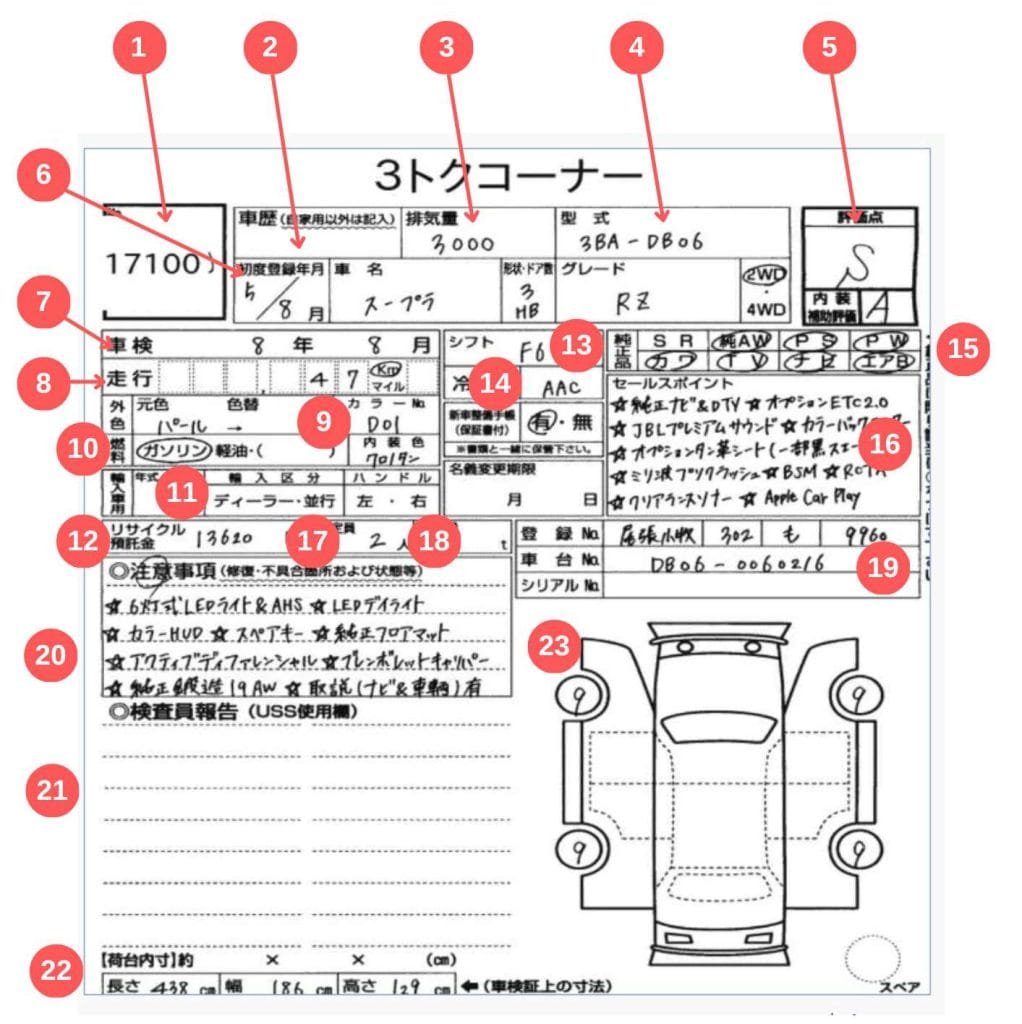
An auction sheet is a crucial document for purchasing cars in Japan, providing detailed information about a vehicle's condition. Every car at Japanese auctions comes with one of these sheets. Sakura Holdings offers translation services for these auction sheets, making them accessible in English for all their customers. As understanding auction sheets can be complex and requires expertise, it's recommended to revisit this page often to enhance your understanding and skills in interpreting them.

How to Read Auction Condition Reports

An auction sheet is a crucial document for purchasing cars in Japan, providing detailed information about a vehicle's condition. Every car at Japanese auctions comes with one of these sheets. Sakura Holdings offers translation services for these auction sheets, making them accessible in English for all their customers. As understanding auction sheets can be complex and requires expertise, it's recommended to revisit this page often to enhance your understanding and skills in interpreting them.

What is the significance of auction grades?

Each vehicle at an auction is assigned an 'Auction Grade', a numerical value reflecting its overall condition. These grades help filter your search based on the general condition of the cars.

It's important to remember that these grades can vary slightly between different auctions and inspectors. Always ensure you have a complete translation before bidding. Even cars with high grades, such as 4.5, might have significant issues despite being generally excellent.

Grade 5 cars are exceptional or almost perfect. It's quite rare to find a car older than 10 years with this grade.

Cars with a 4.5 grade are outstanding for their age, having minimal and easily fixable defects. Finding a car older than 15 years with this grade is uncommon.

Cars with a grade of 4 are better than average for their age. They may have some minor paint fading, and medium-sized dents, and usually have 100,000 km or less on the odometer.

The most frequently seen grade is 3.5. Cars in this category can be in good condition, but it's important to scrutinize their condition notes for issues like larger dents, peeling paint, or high mileage (usually between 100,000 and 200,000 km).

Grade 3 cars vary widely. They could be in overall poor condition, have significant issues like rust or mechanical failures, or have had minor accidents without requiring frame repair.

Cars graded as 2 are usually in very poor condition, often only suitable for parts. They typically have serious rust issues affecting the floorboards, body panels, and frames.

R' grade cars are those that have undergone repairs following an accident. They are not salvage or write-off vehicles. The extent of the accident can vary, meaning the quality of R-grade cars ranges significantly.

*** Triple star or '0' grade cars are not assigned a specific grade and do not undergo inspection. Typically, these vehicles are involved in accidents and haven't been repaired, or they have other major issues. Most often, these cars are non-operational.

How are interior and exterior grades assessed?

The grading system for a car's interior and exterior is straightforward.

Similar to the numerical grade mentioned earlier, the letter grade provides a useful initial insight but isn't sufficient alone to determine if the car is worth bidding on. A thorough review of the report and diagram sections, which are detailed later, is necessary.

'A' grade signifies exceptional condition, which is rare for vehicles over 10 years old unless exceptionally well-maintained.

'B' grade interiors are generally in good condition. While the vehicle might be dirty or have wear on the steering wheel and shift knob, there shouldn't be any major issues or need for significant repairs.

Many vehicles aged 15 years or older fall into the 'C' grade category. This grade can vary widely; in some auctions, it's the lowest grade, while in others, it's relatively moderate. The condition of grade 'C' interiors can range from excellent to poor, so it's crucial to check the report for specific damage details.

Grades 'D' and 'E' are typically not used by larger auctions and represent interiors you'd expect to be in poor condition, possibly with cracked dashboards, sagging headliners, ripped seats, stains, or missing interior sections.

Frequently Asked Questions

Generally, yes. However, some cars at auctions may have unverified mileage. This will be noted on the auction sheet with symbols like *, #, or $. Our translation will always clarify this.

Once you have an active account, we’ll translate the auction sheets for you, covering sales points, notes, the report, and any Japanese on the diagram notes. Note that Sakura Holdings provides complete translations.

The auction sheet is jointly written by the seller and the auction inspector. The seller provides the car information, sales points, and notes, while the inspector handles the condition report and diagram notes, also verifying the seller’s information for accuracy.

While there are minor differences between auction sheets from various auctions, they generally follow the same basic format, which is consistent across major auctions.


Be cautious with vehicle photos; they often don’t accurately represent the car’s condition. Instead, focus on thoroughly reviewing the auction sheet’s body diagram to assess the vehicle’s quality.

Auctions are independent entities, not affiliated with the sellers. They are paid regardless of whether a car is sold. With over 100 auctions in Japan competing with each other, unreliable inspections would deter buyers from an auction.

ou’re free to buy cars of any grade, from pristine to project cars. However, most buyers of lower-grade cars tend to be dissatisfied. Unless you’re skilled in car restoration, the extent of work needed to refurbish a car is often underestimated.

Sometimes, inspectors might miss details on the auction report. If this occurs, we can claim with the auction. Depending on their policy, you might receive a monetary refund or an option to return the vehicle. Note that cars over 10 years old usually aren’t eligible for claims regarding condition or mechanical issues.

en_USEnglish

Compare Listings

Compare (0)